Nonprofit Fund Accounting for Transparency, Control, and Compliance

Transparency. Accountability. Trust.
Managing a nonprofit isn’t just about the mission. It’s about control, visibility, and compliance. Traditional accounting tracks profit and loss for owners. Nonprofit fund accounting tracks accountability across donor restrictions, board designations, grants, and organization-wide reporting.
You aren’t just spending money. You are managing obligations that carry legal, operational, and reputational consequences. When your organization is balancing multiple grants, restricted support, shared costs, and program activity across departments, every dollar must stay mapped to purpose, timing, and reporting requirements.
Mistakes here are costly. A mix-up in funds isn’t just a typo. It is a compliance nightmare. Inaccurate reporting leads to IRS notices. It leads to lost grants. It can even lead to the automatic revocation of your tax-exempt status.
Master your books. Protect your mission.
Fund Architecture: Building Financial Control Across Complex Operations
Structured. Clear. Defensible.
Fund accounting is not a simple “bucket” exercise. It is an operating system for financial control. Your structure must support multiple revenue streams, grant periods, board reporting needs, and audit-ready documentation.
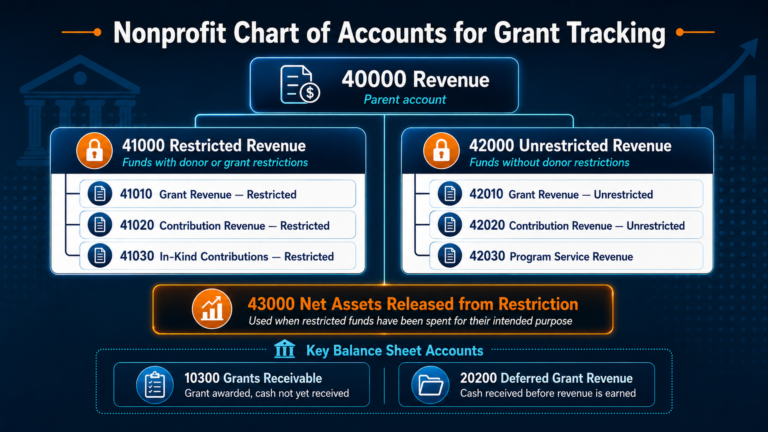
Each fund should map cleanly to restrictions, departments, programs, and reporting outputs. That means your accounting system needs more than separation. It needs consistency across the chart of accounts, classes, segments, and close process.
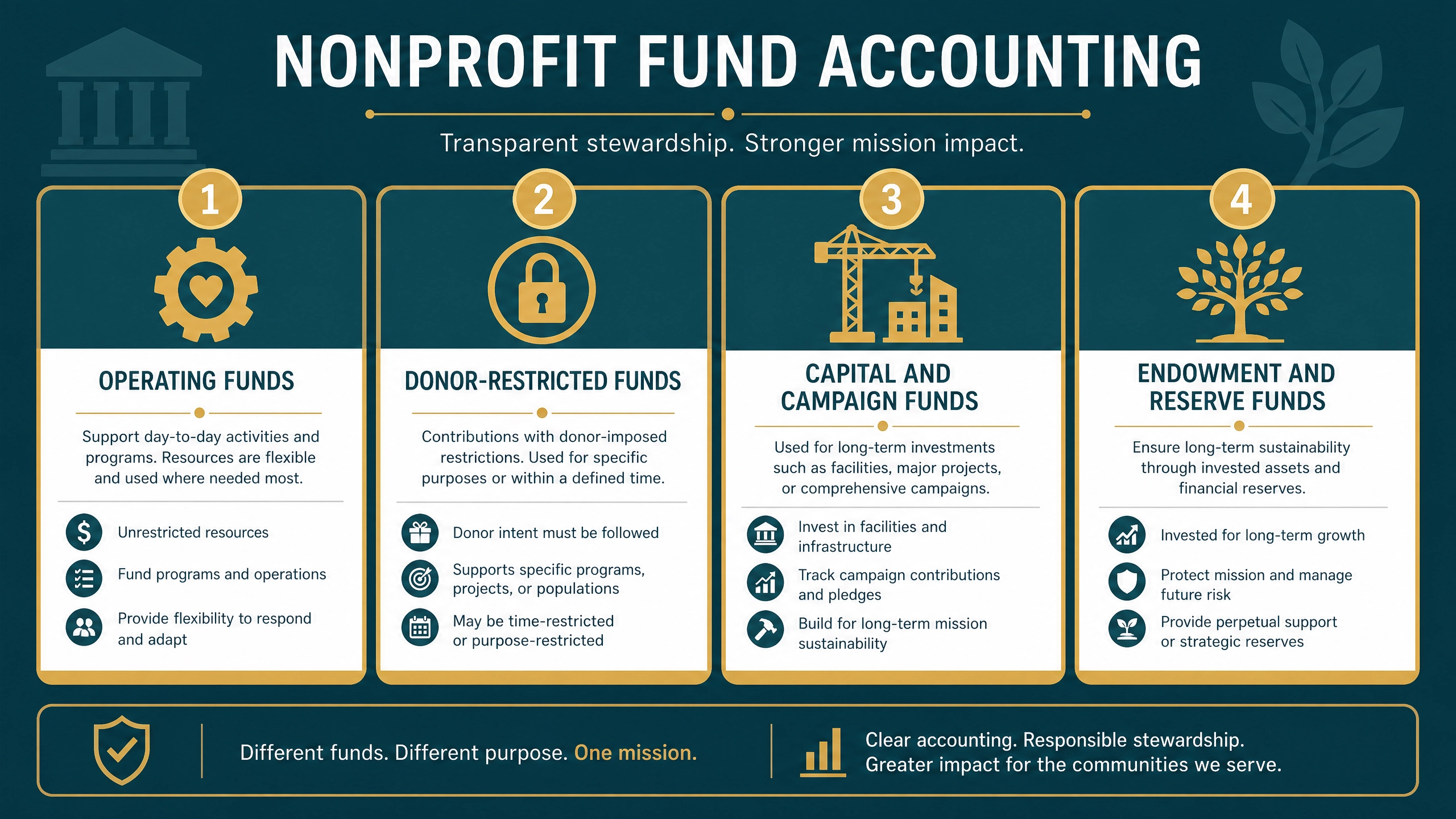
Precision supports confidence.
- Operating Funds: Core mission support, general operations, and flexible revenue.
- Donor-Restricted Funds: Purpose-restricted and time-restricted support requiring documented release activity.
- Capital and Campaign Funds: Long-horizon projects with separate tracking for pledges, expenditures, and board oversight.
- Endowment and Reserve Funds: Balances requiring disciplined investment, spending, and net asset presentation.
If your books do not reflect that architecture, leadership loses visibility fast. Cash may look strong on paper while usable liquidity is far tighter once restrictions, designations, and grant commitments are applied.
Net Asset Reporting: Restriction Tracking That Holds Up Under Review
Clarity prevents exposure.
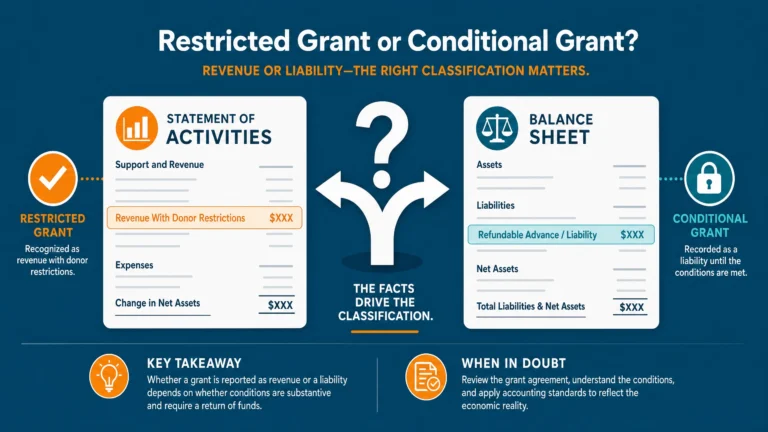
The issue is not whether restrictions exist. It is whether they are being tracked, released, reported, and communicated correctly across finance, development, and leadership. Misalignment here creates audit issues, board confusion, and Form 990 reporting risk.
1. Net Assets Without Donor Restrictions
These balances give leadership room to operate, but they still require discipline. Many organizations separate true operating liquidity from internally designated reserves, quasi-endowments, and board-approved strategic funds to avoid overstating flexibility.
2. Net Assets With Donor Restrictions
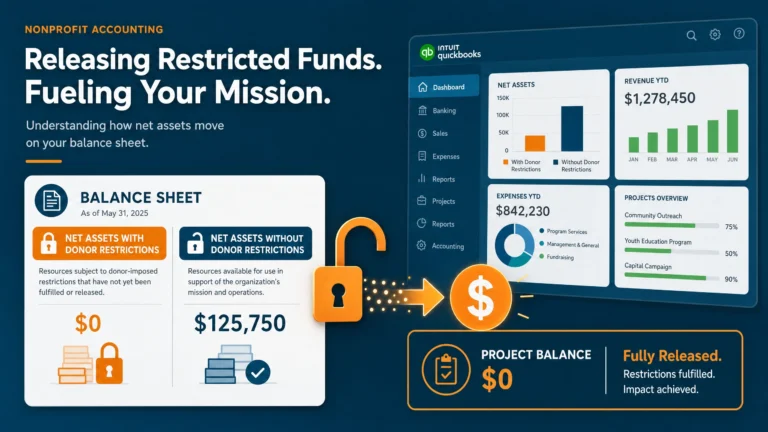
These balances require exact tracking by purpose, period, and release condition. In practice, that often means reconciling grant agreements, pledge schedules, and program spend reports every month, not just at year-end.
- Purpose Restrictions: Support tied to a defined initiative, location, or program objective.
- Time Restrictions: Support unavailable until a future period or earned over a grant timeline.
- Perpetual Restrictions: Endowment principal that must remain intact, with only authorized earnings available for use.
Restrictions are legal obligations.
Donor intent failures rarely start with bad intent. They start with weak reconciliation, delayed close cycles, or disconnected systems. This is why specialized Form 990 Preparation is vital: your financial statements, releases from restriction, and public reporting all need to align.
Functional Expense Allocation: Where Scrutiny Builds Fast
Documented. Rational. Consistent.
Functional expense reporting is not a basic compliance task. It is a governance issue. Your allocation methodology must be supportable, repeatable, and tied to real operational data.
Every shared cost needs a defensible basis for allocation. Salaries, occupancy, IT, executive oversight, and finance support often span multiple functions. If the methodology is informal or inconsistently applied, your statements and Form 990 can quickly become misaligned.
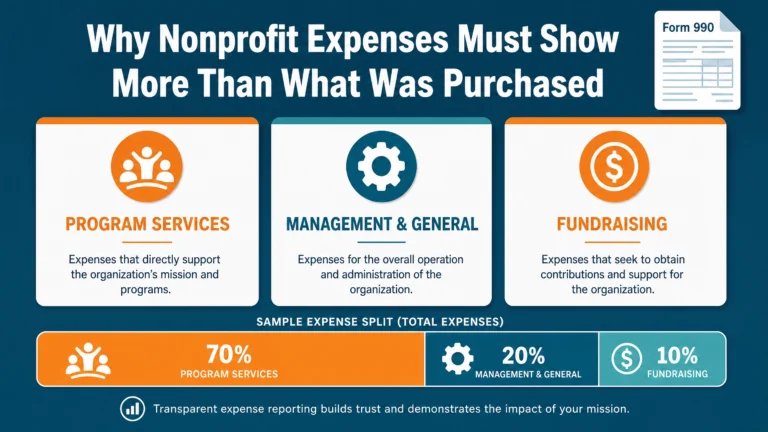
- Program Services: Direct mission delivery, program supervision, and program-specific support costs.
- Management & General: Organization-wide oversight, finance, governance, audit, compliance, and administrative infrastructure.
- Fundraising: Development staff, donor cultivation, campaign costs, and contribution processing.
Methodology matters.
Strong organizations document allocation drivers in writing. Time studies. Square footage. Headcount. Transaction volume. The goal is not to minimize overhead at all costs. The goal is to produce reporting that is accurate, explainable, and durable under review.
When we handle your IRS Notice Support, we often find that “red flags” begin with unsupported allocations. Accuracy isn’t just for the board — it’s for the IRS.
The Cost of Chaos: Why Messy Books Risk Your Status
Confusion is a liability.

If your fund accounting is a mess, your Form 990 will be a mess. The Form 990 is your public report card. Donors, grantors, and the IRS all read it.
If your “buckets” don’t balance, it signals a lack of internal controls. This makes you a target for an audit. Worse, it creates an existential threat to your organization.
Messy books invite audits.
- IRS Penalties: Late or incorrect filings lead to heavy fines.
- Automatic Revocation: Missing filings for three consecutive years means you lose your tax-exempt status instantly.
- Donor Flight: Major donors will not give to an organization that cannot prove where the money goes.
Revoked doesn’t mean finished.
If you have already fallen behind, don’t panic. We specialize in Determination Reinstatement. We guide you through the process of fixing the past and securing your future. We turn “Revoked” back into “Exempt.”
Close Process Discipline: Staying Audit-Ready Year-Round
Monthly. Controlled. Leadership-ready.
Fund accounting should run through a disciplined monthly close. The goal is not just clean books. The goal is timely, decision-useful reporting that leadership and the board can trust.
1. Standardize Fund and Segment Structure
Confirm that your chart of accounts, classes, departments, and grant tracking all follow one reporting logic. If development, programs, and finance use different naming conventions, compliance risk rises fast.
2. Reconcile Restrictions Monthly
Match restricted balances to donor agreements, grant schedules, and release activity every month. Do not wait until audit prep or Form 990 season to reconstruct intent.
3. Formalize Allocation Methodologies
Document how you allocate salaries, occupancy, technology, and administrative support across functions and programs. Then apply those rules consistently across every close cycle.
4. Review Leadership-Level Reports
Close the books on schedule and review the Statement of Activities, Statement of Financial Position, budget-to-actuals, and fund rollforwards. Leadership should be able to see usable operating cash, restricted balances, and emerging compliance issues immediately.
Consistency protects scale.
The Partnership: We Handle the Tax, You Handle the Mission
Expert. Focused. Dedicated.
Fund accounting is complex. It requires dual expertise in both accounting standards and IRS regulations. At Nonprofit Accounting Service, we bring both. We are CPAs and EAs who work only with nonprofits.
We don’t just “do taxes.” We protect your organization’s integrity. Whether you need a fresh Form 990, help with an IRS Notice, or a full Reinstatement, we are your partner in compliance.
Ready to get your books in order?
Don’t let financial complexity stand in the way of your impact. Let’s make sure your funds are accurate, your reporting is defensible, and your organization is ready for every level of scrutiny.