How Nonprofits Should Separate Expenses: Program, Management, and Fundraising
By desarie@andersonaccounting3.com July 24, 2026
When a nonprofit purchases supplies, pays a staff member, or covers the cost of rent, the natural question is: what was the money spent on? But for a nonprofit, that question is only half of what the financial statements need to answer. The other half is: why was the money spent?
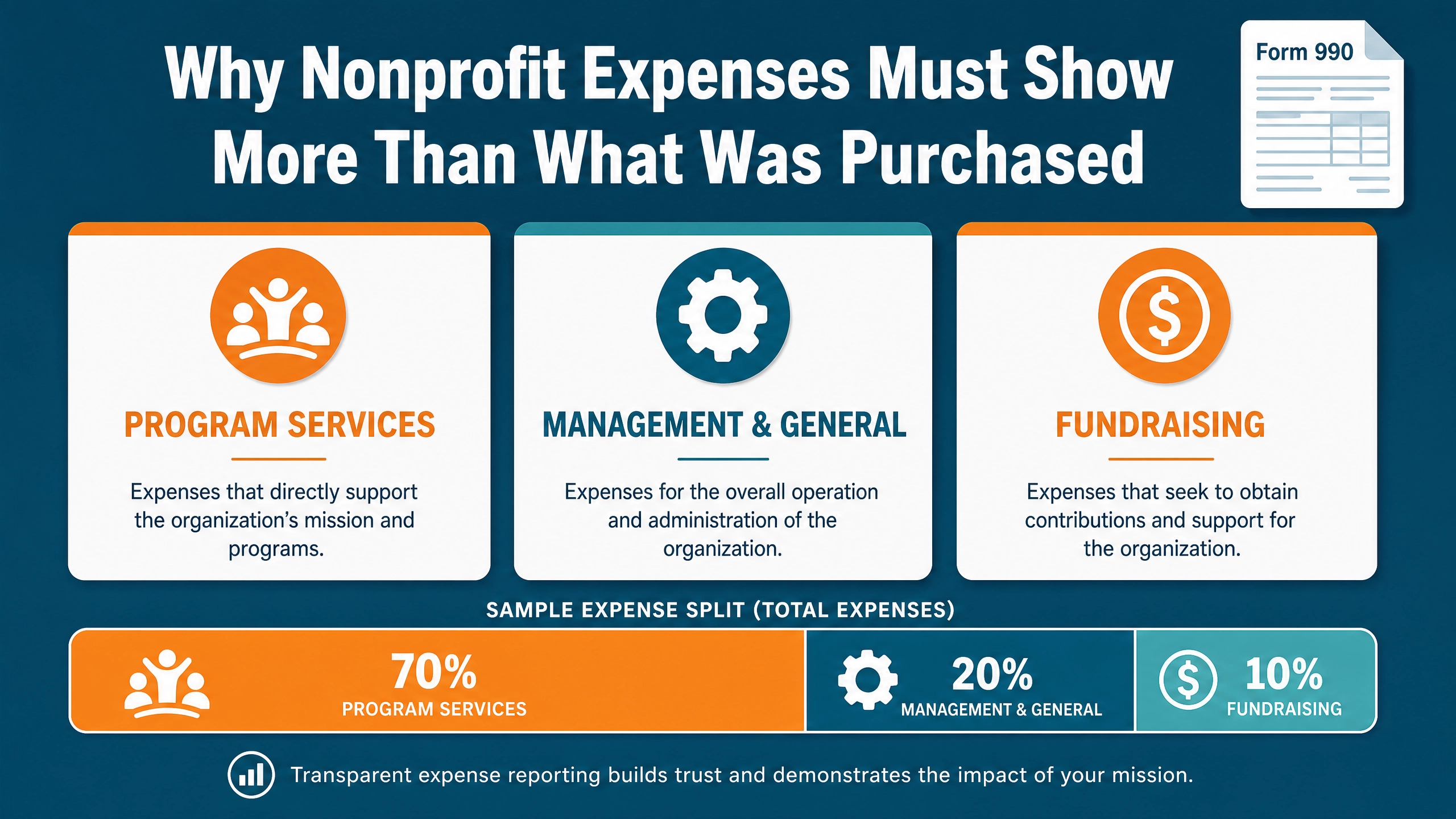
That second question is what functional expense reporting is designed to answer. Under U.S. Generally Accepted Accounting Principles (GAAP) and IRS reporting requirements, nonprofits must separate their expenses into three functional categories (program services, management and general, and fundraising) so that anyone reading the financial statements can see not just what was purchased, but what purpose each dollar served.
Where This Requirement Comes From
The requirement to report expenses by function comes from two authoritative sources that every nonprofit operating in the United States must follow.
The first is FASB ASC 958-720, the section of the Financial Accounting Standards Board’s Accounting Standards Codification that governs nonprofit expense reporting. Under ASC 958-720-45-15, all nonprofits are required to present information about all expenses in one location. That location can be on the face of the statement of activities, in a schedule in the notes to the financial statements, or in a separate financial statement. Whichever presentation is used, it must show the relationship between functional classification (program services, management and general, fundraising) and natural classification (salaries, rent, supplies, professional fees, and so on). This requirement applies to all nonprofits that follow U.S. GAAP, regardless of size.
The second is IRS Form 990, Part IX, the Statement of Functional Expenses. Section 501(c)(3) and 501(c)(4) organizations that file the full Form 990 are required to complete all four columns of Part IX: total expenses, program service expenses, management and general expenses, and fundraising expenses. The IRS uses this information to assess whether the organization is operating consistently with its exempt purposes, and the public uses it to evaluate how the organization allocates its resources.
Both requirements point to the same underlying principle: nonprofit expenses must be reported by function, not just by type.
The Three Functional Categories
The IRS Form 990 instructions for Part IX provide the official definitions of each functional category. Understanding these definitions is the starting point for any allocation decision.
Program Services
According to the IRS Form 990 instructions, program services are “mainly those activities that further the organization’s exempt purposes.” These are the activities for which the organization exists. They include the direct delivery of services, programs, or goods to the people, communities, or causes the nonprofit was formed to serve.
Program service expenses are the costs directly associated with conducting those activities. A food bank’s cost of purchasing and distributing food is a program expense. A literacy organization’s cost of books, tutoring staff, and classroom space used for its reading programs is a program expense. A health organization’s cost of providing medical screenings is a program expense. The common thread is that the expense is incurred in direct connection with carrying out the organization’s mission.
The IRS instructions also note that program services can include an organization’s unrelated trade or business activities when those activities are part of the organization’s exempt function. Lobbying expenses may be included in program services if the lobbying is directly related to the organization’s exempt purposes.
One important boundary: fundraising expenses should not be reported as program service expenses, even if one of the organization’s stated purposes is to solicit contributions. The fact that an activity benefits a program does not, by itself, make it a program expense.
Management and General
The IRS Form 990 instructions define management and general expenses as those that “relate to the organization’s overall operations and management, rather than to fundraising activities or program services.” These are the costs of keeping the organization running. They include the infrastructure that supports everything else the nonprofit does.
The IRS instructions specify that management and general expenses typically include the salaries and expenses of the organization’s chief executive officer and staff, unless a portion of their time is spent directly supervising program services or fundraising activities. When that is the case, those salaries must be allocated proportionally across the relevant functions. Other costs that belong in management and general include board of directors meetings, committee and staff meetings not related to specific programs or fundraising, general legal services, accounting, auditing, human resources, general liability insurance, office management, preparation and distribution of the annual report, and management of investments.
FASB ASC 958-720 similarly describes management and general as encompassing general oversight, corporate governance, accounting, budgeting, financing, human resources administration, and all other management and administration that is not the direct conduct of program services, fundraising, or membership development activities.
A key point from the IRS instructions: expenses incurred to manage investments must be reported in management and general. Lobbying expenses that do not directly relate to the organization’s exempt purposes also belong in this column.
Fundraising
The IRS Form 990 instructions define fundraising expenses as “the expenses incurred in soliciting cash and noncash contributions, gifts, and grants.” This includes all expenses incurred in publicizing and conducting fundraising campaigns, soliciting bequests and grants from individuals, foundations, other organizations, or governmental units, participating in federated fundraising campaigns, preparing and distributing fundraising manuals and materials, and preparing to solicit or receive contributions.
FASB ASC 958-720 describes fundraising activities as those “undertaken to induce potential donors to contribute money, securities, services, materials, facilities, other assets, or time.”
A practical distinction from the IRS instructions: the cost of soliciting a contribution from a government agency is a fundraising expense, but the cost of soliciting a fee contract from the same government agency is a management and general expense. The determining factor is the type of funding being sought. If it is contributed funding, the solicitation cost is fundraising. If it is earned revenue for services provided, the solicitation cost is management and general.
Why the Separation Matters
Separating expenses by function is not simply a filing requirement. The information produced by functional expense reporting flows directly into the reports that boards, funders, auditors, and the public use to understand and evaluate the organization.
| Report or Process | How Functional Expense Data Is Used |
|---|---|
| Form 990 | Part IX requires all four columns to be completed for 501(c)(3) and 501(c)(4) organizations. The data is publicly available and used by donors, watchdog organizations, and regulators to assess how the organization uses its resources. |
| Board Reports | Board members use functional expense data to evaluate whether the organization is directing sufficient resources toward its mission and to make decisions about staffing, programs, and overhead. |
| Grant Reporting | Many funders require a breakdown of how grant funds were spent by function. A grant restricted to program services requires documentation that the funds were used for program activities, not management or fundraising. |
| Audit | Auditors review the organization’s functional expense allocation methodology and test whether expenses are correctly classified. Inconsistent or undocumented allocation methods are a common audit finding. |
| Financial Statements | Under FASB ASC 958-720, the statement of functional expenses must show both the functional classification and the natural classification of all expenses in one location, giving stakeholders a complete picture of how resources were used. |
The functional expense breakdown is also one of the primary data points used by charity evaluators and donors to assess organizational efficiency. A nonprofit that can clearly demonstrate that the majority of its expenses are directed toward program services, and that its management and fundraising costs are reasonable and well-documented, is in a stronger position with funders and the public than one whose expense allocation is unclear or inconsistent.
Allocating Expenses That Serve More Than One Function
Many nonprofit expenses do not fall cleanly into a single functional category. Salaries are the most common example. A staff member who spends time on program delivery, administrative tasks, and donor cultivation cannot have 100 percent of their salary reported in any one column. The allocation must follow how the employee’s time is actually spent. If an employee spends 40 percent of their time on fundraising and 60 percent on program management, the salary must be split 40 percent to fundraising and 60 percent to program services. It cannot be reported as 100 percent program expenses simply because the employee spent more than half of their time on program activities.
Rent and occupancy costs present a similar challenge. If an organization’s office space is used for program delivery, administrative work, and fundraising activities, the cost of that space must be allocated across the relevant functions. The IRS instructions and FASB ASC 958-720 both require that the allocation method be reasonable and consistently applied. Common allocation bases include square footage for occupancy costs and time tracking for salaries.
FASB ASC 958-720 requires that when an organization allocates expenses across functions, it must disclose in the notes to its financial statements which specific expenses are allocated and the method used to determine the allocation. This disclosure requirement exists because the allocation method affects the functional expense totals, and readers of the financial statements need to understand the basis for those totals.
Common Misclassification Errors
Functional expense misclassification is one of the most frequently identified issues in nonprofit financial reporting. The most common errors fall into a few recurring patterns.
Overstating program expenses. Some organizations classify expenses as program costs because the activity generally supports the mission, even when the expense is not directly connected to the conduct of a specific program. Under FASB ASC 958-720, the standard for allocating an expense to program services is direct conduct or direct supervision of program activities. It is not enough that the activity benefits a program in some general way. Expenses that do not meet that standard belong in management and general.
Understating fundraising expenses. If employees are meeting with donors, cultivating relationships, or participating in grant solicitation activities, a portion of their compensation belongs in the fundraising column. Organizations sometimes omit these allocations because the employees are not formally titled as fundraisers, but the functional classification follows the activity, not the job title.
Misclassifying management and general costs. Accounting, human resources, payroll, and grant accounting are management and general expenses under FASB ASC 958-720. These costs benefit the organization as a whole and cannot be allocated to program services simply because programs benefit from having accurate financial records or well-managed staff.
Failing to document the allocation methodology. The allocation method used to distribute shared costs across functions must be documented and applied consistently. An organization that changes its allocation methodology from year to year without explanation, or that cannot produce documentation supporting its allocation decisions, creates a significant audit risk and undermines the reliability of its financial statements.
What This Looks Like in Practice
Consider a nonprofit that provides job training services to adults. Its expenses for the year include staff salaries, rent, supplies, and professional fees. Here is how the functional classification might work in practice:
| Expense | Program Services | Management & General | Fundraising | Basis for Allocation |
|---|---|---|---|---|
| Job trainer salaries | 100% | 0% | 0% | Direct program staff |
| Executive director salary | 60% | 30% | 10% | Time log / documented estimate |
| Accounting staff salary | 0% | 100% | 0% | FASB ASC 958-720 (M&G only) |
| Development staff salary | 0% | 0% | 100% | Direct fundraising staff |
| Rent (training rooms) | 70% | 20% | 10% | Square footage |
| Program supplies | 100% | 0% | 0% | Direct program cost |
| Audit fees | 0% | 100% | 0% | IRS Form 990 instructions (M&G) |
| Fundraising event costs | 0% | 0% | 100% | Direct fundraising cost |
The result is a Statement of Functional Expenses that shows, for each natural expense category, how much was spent on each function. That matrix, with natural classifications in the rows and functional categories in the columns, is what FASB ASC 958-720 requires to be presented in one location in the financial statements, and what Form 990 Part IX requires to be reported to the IRS.
Setting This Up in QuickBooks Online
QuickBooks Online does not have a built-in Statement of Functional Expenses, but it can be configured to track the information needed to produce one. The most straightforward approach is to use the Classes feature to tag each transaction with its functional category at the time of entry: Program Services, Management and General, or Fundraising. When expenses are coded consistently at the transaction level, the functional expense totals can be pulled from the Profit and Loss by Class report at any time.
For expenses that must be split across functions, such as the executive director’s salary or occupancy costs, a journal entry can be used to allocate the expense across the relevant classes based on the documented allocation methodology. The allocation basis (time percentage, square footage, or other reasonable method) should be documented and applied consistently each period.
For restricted funds and grant tracking, the Projects feature in QuickBooks Online provides a separate layer that works alongside functional classification. Projects can track income and expenses tied to a specific grant or restricted funding source, which makes it easier to produce grant-specific reports without disrupting the functional expense structure. The functional classification (program, management, fundraising) and the project tracking serve different purposes and can be used together in the same file.
The goal is to have a system that can produce, at any point in time, a clear picture of how much was spent on program services, how much on management and general, and how much on fundraising, with documentation to support each allocation decision.
The Bottom Line
Nonprofit expenses must show more than what was purchased. They must show why the money was spent. That is the purpose of functional expense reporting. It gives every stakeholder who reads the financial statements a clear, documented answer to the question of how the organization’s resources were used in relation to its mission.
The three functional categories (program services, management and general, and fundraising) are defined by IRS Form 990 instructions and FASB ASC 958-720. The definitions are specific, the allocation requirements are documented, and the reporting appears in the financial statements, the Form 990, and the notes. Getting the classification right matters for every report that flows from the financial statements.
If your organization is reviewing how expenses are currently classified, or if your financial reports do not clearly show the functional breakdown of your spending, our nonprofit accounting team can help you evaluate your current setup and build an allocation methodology that is consistent, documented, and audit-ready.
Sources: IRS Instructions for Form 990 (2025), Part IX — Statement of Functional Expenses (irs.gov/instructions/i990); FASB Accounting Standards Codification ASC 958-720, Expenses of Not-for-Profit Entities (asc.fasb.org).