Restricted Grant: Revenue or Liability? What Nonprofits Need to Know
One of the most common nonprofit accounting questions is whether a restricted grant belongs on the Statement of Activities as revenue or on the balance sheet as a liability. Many organizations assume that any grant with strings attached must stay off the income statement until the money is spent. That assumption is not always correct — and acting on it can lead to financial statements that misrepresent your organization’s true financial position.
The answer depends on one distinction that changes everything: the difference between a donor restriction and a donor condition.
Restricted Does Not Automatically Mean Liability
A restricted grant is one where the donor or grantor has specified how the funds must be used — for a particular program, population, activity, or time period. The nonprofit cannot use those funds freely for general operations. That limitation is real, and it must be reflected in the financial statements.
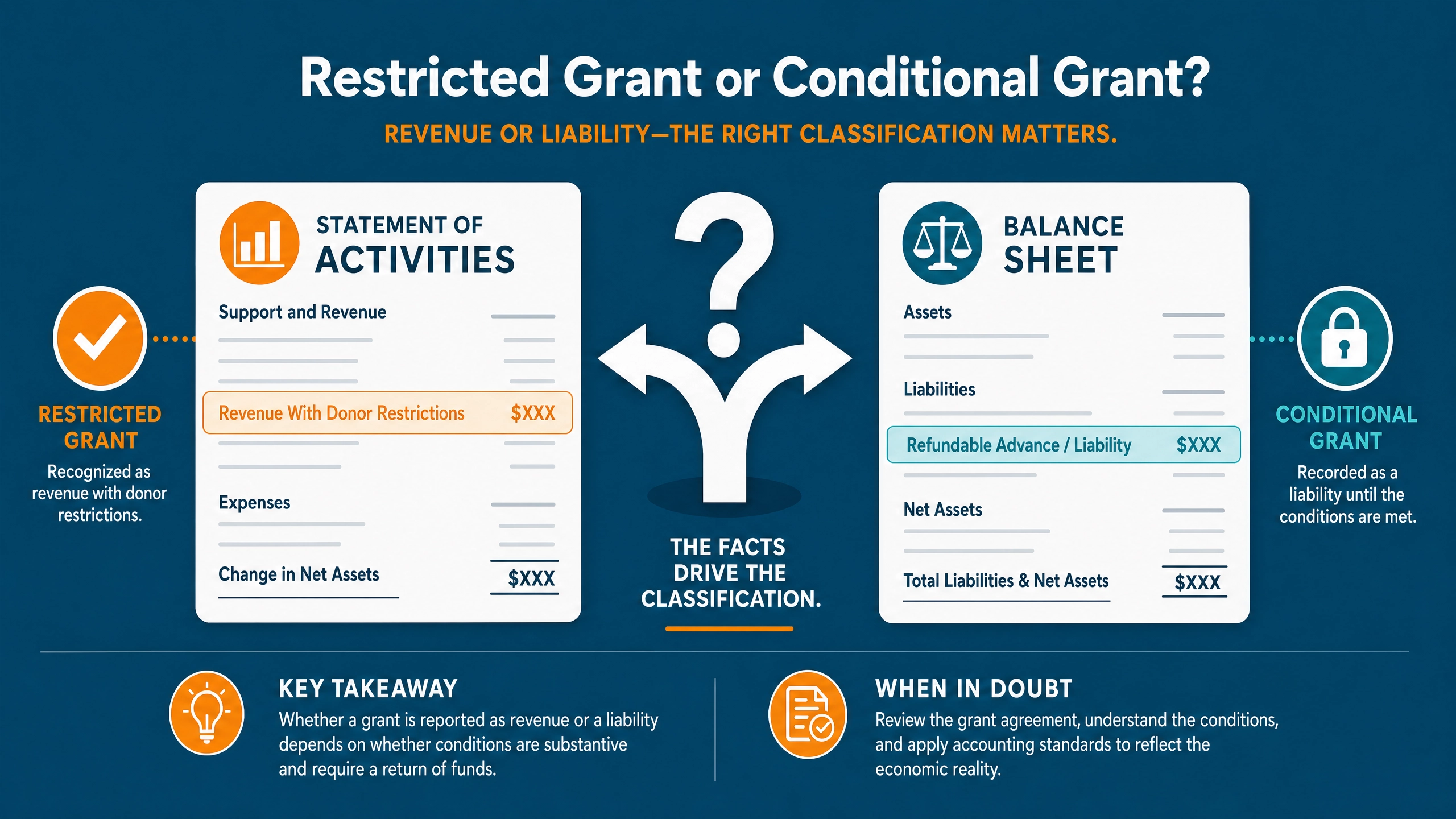
However, a restriction on how money can be used is not the same as a barrier that prevents the organization from recognizing the money as revenue. If a nonprofit has received the funds, or has an unconditional right to receive them, and the only limitation is how they must be spent, the grant is generally recorded as revenue with donor restrictions on the Statement of Activities.
The restriction tells the nonprofit where the money must go. It does not tell the nonprofit that it has not yet earned the right to count the money as revenue.
The Core Distinction: Restriction vs. Condition
Understanding the difference between a restriction and a condition is the foundation of correct grant accounting.
| Term | What It Governs | The Question It Answers |
|---|---|---|
| Donor Restriction | Classification — how the money can be used | What is this money allowed to be spent on? |
| Donor Condition | Timing — when revenue can be recognized | Has the nonprofit earned the right to keep this money? |
A restriction answers the question of purpose. A condition answers the question of entitlement. Both can exist in the same grant agreement — but they affect the accounting in entirely different ways.
Consider two examples side by side. A foundation awards a nonprofit $100,000 to be used for programs serving youth under age 18. The nonprofit receives the funds, there is no matching requirement, no performance threshold, and no right of return if the money is not spent by a specific date. This grant is restricted — the money must go to youth programming — but it is unconditional. The nonprofit records it as revenue with donor restrictions.
Now consider a different grant. A grantor awards up to $100,000, but the nonprofit can only draw down funds after incurring approved expenses and submitting documentation for reimbursement. The nonprofit has not yet earned the right to the funds simply by receiving an award letter. This grant is conditional. Funds received before the condition is met may need to stay on the balance sheet as a liability until the condition is satisfied.
When a Restricted Grant Is Recorded as Revenue
A restricted grant is generally recorded as revenue with donor restrictions when the nonprofit has received the funds — or has an unconditional right to receive them — and the only limitation is how the money must be used. No barrier must be overcome. No matching funds are required. No performance target must be reached before the organization is entitled to keep the award.
The journal entry at the time of receipt looks like this:
| Account | Debit | Credit |
|---|---|---|
| Cash | $25,000 | |
| Grant Revenue — Without Donor Restrictions | $25,000 |
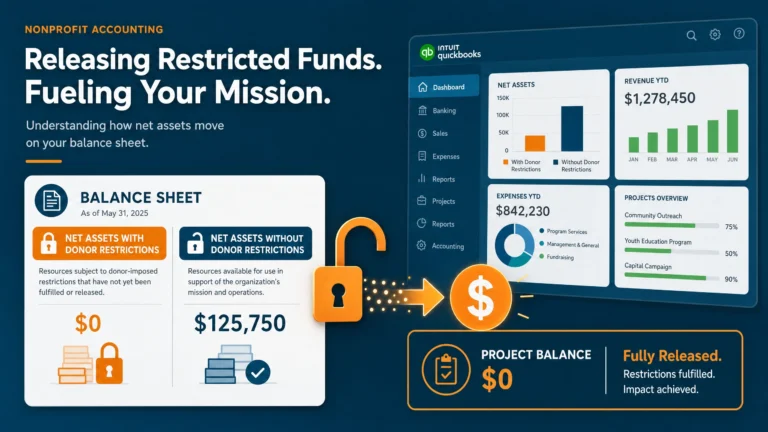
This revenue appears on the Statement of Activities as revenue with donor restrictions. As the nonprofit spends the funds on qualifying program expenses, a release from restriction is recorded for the amount spent. The unspent portion remains in net assets with donor restrictions on the balance sheet until it is used for the intended purpose.
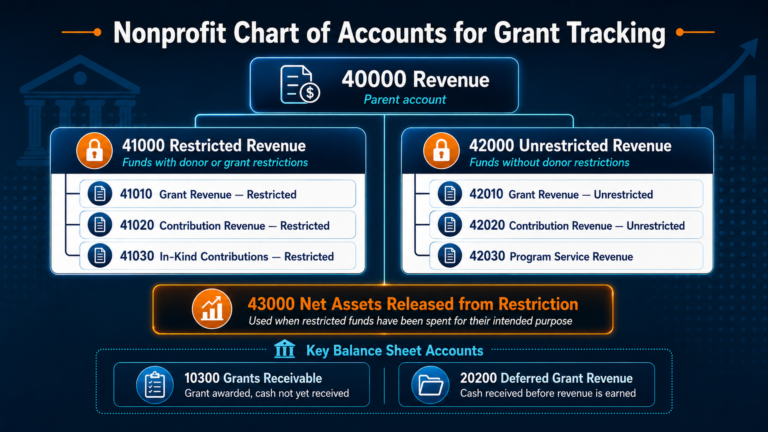
It is worth noting that in QuickBooks Online, the account name itself can communicate the restriction clearly. Using a naming convention such as Grant Revenue — Without Donor Restrictions (for example, account 41010) and Grant Revenue — Without Donor Restrictions (account 42020) makes the Statement of Activities easier to read and helps anyone reviewing the financials immediately understand which revenue is available for general use and which is committed to a specific purpose. Some organizations also use the Locations feature in QuickBooks Online as an additional layer to separate restricted and unrestricted activity across reporting columns.
When a Grant May Stay on the Balance Sheet
A grant may need to remain on the balance sheet as a liability if the nonprofit has not yet met the condition required to recognize the funds as revenue. Common examples of conditions that delay revenue recognition include:
- The nonprofit must raise matching funds before the grantor is obligated to provide the award
- The nonprofit must incur approved expenses and submit reimbursement documentation before drawing down funds
- The nonprofit must serve a specific number of participants before it has the right to retain the award
- The agreement includes a right of return — meaning the grantor can require the funds back if the nonprofit does not meet the requirement
In these situations, cash received before the condition is met is generally recorded as a liability, commonly referred to as a refundable advance.
| Stage | Account | Debit | Credit |
|---|---|---|---|
| Cash received before condition is met | Cash | $100,000 | |
| Refundable Advance (Liability) | $100,000 | ||
| Condition met — revenue recognized | Refundable Advance (Liability) | $25,000 | |
| Grant Revenue | $25,000 |
As the nonprofit meets the condition — by incurring approved expenses, reaching a performance milestone, or satisfying the matching requirement — the liability is reduced and revenue is recognized in the corresponding amount. Recording conditional funds as revenue before the condition is met overstates revenue and understates liabilities, which can distort every report that flows from the financial statements.
Common Mistakes Nonprofits Make With Restricted Grants
Treating every restricted grant as a liability. Not all restricted funds belong on the balance sheet. If the grant is restricted but unconditional, it belongs on the Statement of Activities as revenue with donor restrictions. Holding it as a liability understates revenue and misrepresents the organization’s support for the period.
Recording conditional grants as revenue too early. If a grant has a true condition — a barrier the organization must overcome before it is entitled to the funds — revenue should not be recognized simply because management expects to spend the money soon. The condition must be met or substantially met before revenue recognition is appropriate.
Confusing reimbursement grants with restricted contributions. Some grants operate more like reimbursement arrangements, where the nonprofit only earns the funds after incurring approved costs. In these cases, revenue recognition happens as eligible expenses are incurred, not when the award letter is received.
Ignoring the grant agreement. The accounting treatment starts with the language in the award letter, grant contract, or donor agreement. That document determines whether the funds are restricted, conditional, reimbursable, or some combination. There is no shortcut around reading it carefully.
Failing to record releases from restriction. When restricted funds are spent for their intended purpose, a release from restriction must be recorded. This moves the amount from net assets with donor restrictions to net assets without donor restrictions. The release is not new revenue — it is a reclassification between net asset categories. Skipping this step leaves net assets with donor restrictions overstated over time.
Questions to Ask Before Recording Any Grant
Before recording a grant award, nonprofit leadership and accounting staff should review the grant agreement and work through the following questions:
- Is the money restricted for a specific purpose, time period, program, or population?
- Does the organization have to meet a barrier before it is entitled to the funds?
- Is there a right of return if the condition is not met?
- Is the grantor released from its obligation if the nonprofit does not meet the requirement?
- Is this a reimbursement grant where funds are drawn down after expenses are incurred?
- Does the agreement require specific reporting, documentation, or performance outcomes tied to entitlement?
- Has the organization already met the condition at the time the funds are received?
The answers to these questions determine whether the grant is recorded as revenue with donor restrictions, held as a liability, or recognized incrementally as conditions are satisfied.
What This Means for Your QuickBooks Online Setup
QuickBooks Online can support accurate nonprofit grant accounting, but the setup must be intentional. For restricted grants, the organization should be able to answer the following questions directly from its reports at any point in time:
- Was this grant recorded as revenue or as a liability?
- If it was recorded as revenue, is it clearly labeled as revenue with donor restrictions?
- If it was recorded as a liability, what condition must be met before revenue can be recognized?
- How much has been spent for the restricted purpose?
- How much restricted funding remains unspent?
One approach is to set up separate income accounts for revenue with donor restrictions and revenue without donor restrictions — for example, using account numbers in the 41000 range where the account name explicitly states the restriction status. This makes the Statement of Activities straightforward to read and helps board members, auditors, and funders immediately understand the nature of each revenue line.
Another approach keeps the chart of accounts simpler and uses Projects or the Locations feature in QuickBooks Online to track restrictions at the transaction level. Both methods can work. The key is consistency — applying the same structure to every grant, every period, so the reports remain reliable and comparable over time.
Why Accurate Classification Matters Beyond the Books
Misclassifying grant revenue has consequences that extend well beyond a single line on the balance sheet. If conditional funds are recorded as revenue too early, the Statement of Activities overstates support received during the period. If unconditional restricted contributions are held as liabilities, revenue is understated and the financial statements do not accurately reflect what the organization raised. If releases from restriction are not recorded, net assets with donor restrictions accumulate incorrectly over time.
These errors can affect board reporting, grant reporting to funders, audit preparation, cash flow planning, budget decisions, Form 990 preparation, and the confidence of donors and funders who rely on the financial statements to understand the organization’s position.
Restricted grant accounting is not simply a bookkeeping question. It is a financial reporting question — one that shapes how every stakeholder understands what your organization has, what it has committed, and what it is free to use.
The Bottom Line
Restricted funds are not automatically liabilities. A donor restriction tells the nonprofit how the money must be used. A donor condition tells the nonprofit whether it has earned the right to recognize the money as revenue. Those are two separate questions, and they require two separate answers before any grant is recorded.
If a grant is restricted but unconditional, it is recorded as revenue with donor restrictions on the Statement of Activities. If a grant is conditional, funds received before the condition is met may need to stay on the balance sheet as a refundable advance until the condition is satisfied. The grant agreement determines the accounting treatment — read it carefully, identify the restriction, identify the condition, and record the grant accordingly.
A clean grant accounting process includes reviewing each agreement before recording the award, making a clear determination of whether the grant is conditional or unconditional, tracking restricted activity by funding source or project, recording releases from restriction as funds are spent, and reconciling restricted net assets to grant schedules on a regular basis. When that process is in place, the financial statements tell an accurate story — one that your board, your funders, and your auditors can rely on.
If your organization is reviewing how restricted grants are currently recorded, or if your financial reports do not clearly show which funds are available for general use and which are committed to a specific purpose, our nonprofit accounting team can help you evaluate your current setup and build a structure that supports accurate, audit-ready reporting.