7 Mistakes You’re Making with Form 990 Preparation (and How to Fix Them Before Donors See)
Your Form 990 is not a private tax return. It is a public resume.
Donors, grantors, and watchdog groups like GuideStar and Charity Navigator use this document to judge your organization's health. A single error can signal mismanagement, leading to lost funding and a damaged reputation. For many nonprofits, the 990 is the most viewed document they produce annually.
Precision. Transparency. Trust.
If your filing is sloppy, your mission is at risk. Here are the seven most common mistakes nonprofits make with Form 990 preparation and the steady, step-by-step guidance you need to fix them.
1. Misclassifying Functional Expenses
The overhead myth is real, and your numbers are telling a story.
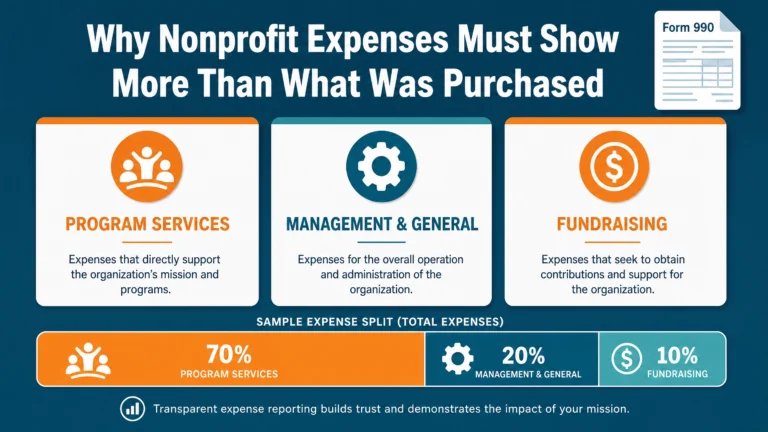
Many organizations fall into the trap of dumping most costs into "Management and General." While it seems simpler, it can artificially inflate your overhead ratio. Donors want to see their money going directly to programs.
The Risk: High overhead ratios trigger red flags for donors and charity evaluators.
The Fix: Implement a robust allocation system. Track staff time and facility usage across Program, Management, and Fundraising categories throughout the year.
Accurate allocation reflects mission impact.

2. Treating Part III as a Compliance Box
Your mission statement is your best marketing tool.
Part III of the Form 990 asks for your program service accomplishments. Too many nonprofits copy and paste a vague, decade-old mission statement. This is prime real estate to showcase your impact to potential major donors.
The Risk: Vague descriptions make your organization look stagnant or irrelevant.
The Fix: Write compelling, outcome-focused narratives. Use data points: number of people served, pounds of food distributed, or lives changed: to prove your effectiveness.
Narratives turn data into donations.
3. Ignoring Governance Policy Checkboxes
Governance is an existential threat if ignored.
The IRS asks specific questions about whether you have a Whistleblower Policy, a Document Retention Policy, and a Conflict of Interest Policy. Checking "No" tells the IRS: and the public: that your board lacks oversight.
The Risk: "No" answers signal weak internal controls and increase audit risk.
The Fix: If you don't have these policies, adopt them now. Ensure your board reviews the Form 990 before it is filed.
Policy compliance protects your status.

4. Discrepancies with Audited Financials
Numbers that don't match create a crisis of confidence.
If your Form 990 says one thing and your audited financial statements say another, you have a problem. Savvy grantmakers will cross-reference these documents. Inconsistency suggests a lack of professional oversight.
The Risk: Discrepancies undermine your credibility and transparency.
The Fix: Perform a formal reconciliation between your books and the 990. Ensure that net assets at the beginning of the year match the prior year’s ending balance.
Consistency builds institutional trust.
5. Filing the Wrong Form Variant
Threshold errors lead to automatic revocation.
The IRS offers different versions of the 990 based on gross receipts and total assets (990-N, 990-EZ, or the full 990). Filing a 990-N when you actually cross the $50,000 threshold can result in penalties or even the loss of your tax-exempt status.
The Risk: Filing the wrong form is treated as a failure to file.
The Fix: Monitor your revenue throughout the year. If you are near a threshold, prepare for the more complex filing early. If you have already lost your status, you need Determination Reinstatement services immediately.
Correct forms ensure legal standing.

6. Failing the Public Support Test (Schedule A)
The public support test is a math problem with high stakes.
To maintain 501(c)(3) status as a public charity, you must generally receive at least one-third of your support from the general public or government units. If you rely too heavily on a single donor or investment income, you may be reclassified as a private foundation.
The Risk: Reclassification leads to higher taxes and stricter regulations.
The Fix: Review Schedule A early in the year. If your public support is dipping, diversify your fundraising efforts or consult with a nonprofit tax expert to assess your status.
Diversified funding secures public status.
7. Incomplete Schedule L (Interested Persons)
Transparency regarding "insiders" is non-negotiable.
The IRS is highly sensitive to "excess benefit transactions": situations where board members or officers benefit personally from the nonprofit. Schedule L is where you disclose loans, grants, or business dealings with "interested persons."
The Risk: Undisclosed insider deals can lead to massive excise taxes and public scandal.
The Fix: Maintain a strict Conflict of Interest disclosure process. Report all related-party transactions accurately. Transparency is your best defense against accusations of impropriety.
Disclosure mitigates the risk of scandal.

Your Mission, Protected.
Don’t let a technicality derail your impact. Form 990 preparation is about more than just checking boxes; it’s about protecting your organization’s future. Whether you need a full Form 990 Preparation, support with an IRS Notice, or help with Determination Reinstatement, we are here to help.
We are nonprofit-only. We never miss deadlines. We bring dual CPA and EA credentials to every filing.
Secure your status. Secure your future.